
Privacy Policy
Purpose
This policy explains, in plain language, how Wild Light Counselling collects, uses, stores and shares your personal information, including your health information. It is the public privacy policy for the Wild Light Counselling website.
Who this covers
Everyone whose information we handle: clients and people who enquire about counselling, parents, carers and support people, referrers and other professionals, counsellors who receive supervision (individually or in groups), people who buy or download resources and workshops, people on our mailing lists, and website and social media visitors.
Who is responsible
Wild Light Counselling [business entity name and ABN] is responsible for your information under the Privacy Act 1988 (Cth), including the Australian Privacy Principles (APPs). As a health service provider, we follow the APPs regardless of the size of our business. Our practice also follows the Australian Counselling Association (ACA) Code of Ethics.
Rach Wheatley, Director and Counsellor, is our privacy officer. Contact: rachel@wildlightcounselling.com.au · 0439662283.
The short version
We only collect what we need to support you well, run the practice and meet the law.
Your information is confidential. We do not share it without your consent unless the law requires or allows it, for example when someone's safety is at serious risk.
We never sell your information, and we never use your health information for marketing.
Your details will never be entered into any AI tool. Your counsellor writes your notes and documents themselves.
Every decision about your care is made by your counsellor, not by software.
You can ask to see or correct your information at any time.
What information we collect
Depending on how you connect with us, this may include:
Contact and identity details: your name, the name you use, pronouns, date of birth, address, email, phone number and emergency contact.
Health information: your reasons for seeking support, mental health and health history, diagnoses or neurotype you choose to share, session notes, safety plans, and any creative work or artwork you choose to share in sessions.
Information about others: details about parents, carers, support people and professionals you ask us to work with.
Supervision information: for supervisees, professional details, registration or membership information, and supervision notes and agreements. Supervisees are asked not to share identifying client details in supervision. Supervisees have the same confidentiality protections as clients.
Funding and billing details: NDIS, plan manager or private health details, invoices and payment records. Card payments are processed by Stripe. We do not see or store your full card number.
Website, workshop and resource buyers, subscribers and visitors: your name, email address, what you bought or signed up for, and website usage data (see "Website, cookies and social media").
Some of this is "sensitive information" under the Privacy Act, such as health information, and information about your racial or ethnic origin, religious or philosophical beliefs, or sexual orientation or gender identity if you choose to share it. We handle it with extra care and only collect it with your consent or where the law allows.
How we collect it
Mostly from you directly: through enquiry and intake forms, email, phone, and sessions (in person or by Telehealth). Sometimes with your consent from others, such as a parent or carer, a referrer, a GP, a school or other professionals.
You are welcome to ask general questions without giving your name. We usually can't provide counselling or supervision anonymously, because professional record-keeping and our ethical obligations mean we need to know who we are working with.
Why we collect it and how we use it
To provide safe, good-quality counselling and supervision.
To keep clinical and supervision records, as professional standards and the law require.
To manage appointments, invoicing and payments.
To respond to your enquiry or manage a waitlist.
To deliver resources, workshops and emails you have asked for.
To meet legal and professional obligations, including insurance, child safety and complaints handling.
We may also use your information for a secondary purpose closely related to these, where you would reasonably expect it.
Who we share it with, and when
We share your information only when:
you have agreed, for example with a GP, school, plan manager or another professional you have named. We ask for your written permission before contacting others on your behalf
it is needed for the service you have asked for, such as a report or letter you have requested
the law requires or allows it, for example a court order, or where we believe it is necessary to lessen or prevent a serious threat to someone's life, health or safety, including child safety concerns
your counsellor is receiving professional supervision or consultation. In that case your information is de-identified wherever possible, and supervisors are bound by confidentiality.
We discuss our client work in our own clinical supervision, and we tell you about this at the start of counselling and in our consent form. We share only what is needed, and we leave out your name and anything that could identify you, including details that might identify you in a small community. Our supervisor is bound by confidentiality. If we ever wanted to record, transcribe or present your session for training, we would ask for your written consent first. You can ask us questions about this, or change your mind, at any time.
People who help us run the practice (administration support, accountant) see only what their role needs and are bound by confidentiality agreements.
If we ever use case material for training, writing or research, we ask for your informed consent first and effectively disguise your identity.
When information may be shared without consent
Your safety, and the safety of others, matters most. If we believe a child or young person is at risk of harm, or someone's life or safety is at serious risk, we may share information with child protection authorities, police or emergency services, as the law requires or permits. Wherever it is safe and appropriate, we will talk with you first. Where possible we also consult our supervisor, and we share only the relevant information with the people who need it.
The systems we use and where your information is stored
We use trusted systems, each with one clear job. Some store or process information outside Australia. Before using any system that stores information overseas, we take reasonable steps to check it protects your information consistently with the APPs.
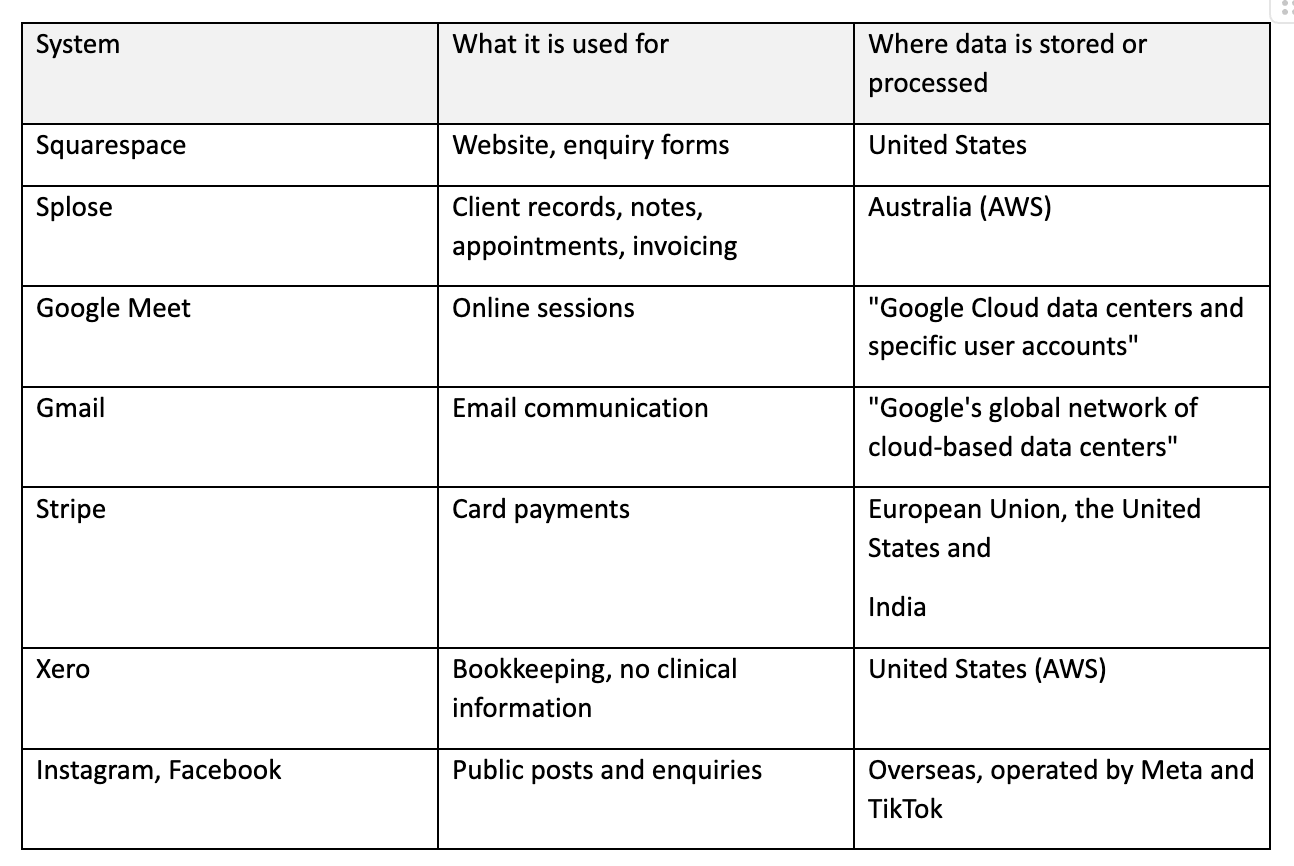
AI tools
Your details will not be used in any AI tool. We do not enter, upload or paste any client, parent or carer, or supervisee information into AI tools. This includes names, contact details, session notes, session content, recordings, transcripts, reports, letters and anything else that could identify you. Your counsellor writes all notes and documents themselves.
AI tools do not make decisions about you, assess you or diagnose you. Your counsellor is fully responsible for your records and care. We may use AI tools for general writing that involves no client or supervisee information, such as drafting resources and social media captions.
Decisions made by computer programs
From 10 December 2026, privacy law requires businesses to explain if they use computer programs to make decisions, or to do things substantially and directly related to making decisions, that could significantly affect your rights or interests.
Wild Light Counselling does not do this. Your counsellor makes every decision about your care, including whether our services are a good fit, what is recommended, how to respond to risk and how sessions are planned. We do not use software to score, rank, prioritise or assess you, or to decide who is offered a place or waitlist spot.
Some steps in our systems are automatic, such as appointment reminders, sending forms and invoices. These are simple admin steps set up in advance and do not make decisions about you.
If this ever changes, we will update this policy first and tell you what kinds of information are used and what kinds of decisions are involved.
Website, cookies and social media
Our website uses cookies and similar technologies to make the site work and to understand how it is used We may use analytics, advertising pixels or similar. You can adjust cookie settings in your browser. Our website links to third-party sites and social media platforms, and we are not responsible for their privacy practices. Please do not share health or personal details with us in public comments or direct messages on social media. Contact us by email or phone instead.
Emails, resources and workshops
If you sign up for a mailing list or buy or download a resource or workshop, we use your details to send you what you have asked for. Every marketing email has an unsubscribe link and we act on it promptly. Clients are never added to a mailing list unless they ask, and what we know from your sessions is never used to market to you.
How we keep your information safe
We use secure, password-protected systems with multi-factor authentication. Counselling and supervision take place in private spaces or secure online platforms. Only people who need access for their role have it.
We keep clinical records for at least 7 years after your last contact, or for clients under 18, until they turn 25 – confirm against the law and your insurer's requirements, as the ACA Code sets no retention period. After that we destroy them securely or de-identify them.
Your identity details and case notes are kept securely within Splose. Arrangements are in place for the safe handling and disposal of records if we are unable to continue practising. Sessions are not recorded or observed by anyone else without your informed consent. At the start of counselling we tell you that we keep appointment and session records, and you can ask how securely they are kept and who can see them.
Seeing or correcting your information
You can ask to see your records or get a copy, or ask for anything that is wrong, out of date or incomplete to be corrected. Email rachel@wildlightcounselling.com.au. We will confirm who you are, then respond within a reasonable time, usually within 30 days. We do not charge for making a request. If there is a reasonable cost for providing copies we will tell you first.
In a small number of situations we may not be able to give you access to everything, for example if it would put someone's safety at serious risk or reveal another person's private information. If that happens we will explain why in writing and tell you what your options are. If we do not agree to a correction, you can ask us to attach a statement of your view to your record.
We can send your records to another health professional with your written request.
Young people and consent
Young people have privacy rights too. Intake forms and meetings are conducted by and with the client's caregiver/s. Where it is deemed therapeutically supportive, a young person will have choice to collaborate in this process. We talk through confidentiality and its limits with every young client and their parent or carer at the start of counselling.
For young people (short version)
What you tell your counsellor stays between you and them. The exceptions are if you or someone else is in serious danger, or if the law says we have to share. We'll always try to talk to you first. You can ask to see your notes. You can say no to things and nothing about your sessions changes.
If something goes wrong
If a data breach happens that is likely to cause you serious harm, we will tell you as soon as possible, explain what happened and what you can do, and notify the Office of the Australian Information Commissioner (OAIC) as required under the Notifiable Data Breaches scheme.
Questions and complaints
If you have a question or concern about your privacy, please contact our privacy officer first:
Phone: 0439662283
Contact form: https://www.wildlightcounselling.com.au/contact
We will acknowledge your complaint within 2 business days and aim to resolve it within 30 days. If you are not happy with our response, you can contact:
Office of the Australian Information Commissioner (OAIC): www.oaic.gov.au · 1300 363 992
Office of the Health Ombudsman (Queensland): www.oho.qld.gov.au · 133 646
Changes to this policy
We review this policy at least once a year, and whenever our systems or the law change. The latest version is always on our website. You can ask for a copy in another format if that is easier for you.
Related legislation and standards
Privacy Act 1988 (Cth), including Australian Privacy Principles 1, 5, 6, 8, 11, 12 and 13, and the Notifiable Data Breaches scheme
Privacy and Other Legislation Amendment Act 2024 (Cth), including automated decision-making transparency (APP 1.7–1.9, from 10 December 2026)
OAIC, APP Guidelines Chapter 1 and APP 1.7–1.9 Transparency Obligation Fact Sheet (September 2026)
Australian Counselling Association Code of Ethics and Practice (Version 16)